Written by Stavros Didakis, Professor, NYU Shanghai.
Public installations refer to art works that are exhibited to open public spaces and their form, function and meaning are created for the general public usually in outdoor spaces. Public art embodies public or universal concepts rather than commercial, partisan or personal interests, and it has clear aesthetic qualities in form or theme. In many cases, the works are interactive and collaborative, allowing the public to enjoy playful and engaging content. The case studies below explore selected examples of such projects.
Chris O' Shea's "Hand from Above" is by far one of the most exciting urban screens project to date. The work encourages us to experience and question our normal routines and behaviors, especially in the public space. "Inspired by Land of the Giants and Goliath, we are reminded of mythical stories by mischievously unleashing a giant hand from the BBC Big Screen. Passers by will be playfully transformed. What if humans were not on top of the food chain? Unsuspecting pedestrians will be tickled, stretched, flicked or removed entirely in real-time by a giant deity”.
The "Hand from Above" was built using openFrameworks and openCV.
Hand from Above (Chris O' Shea, 2009)
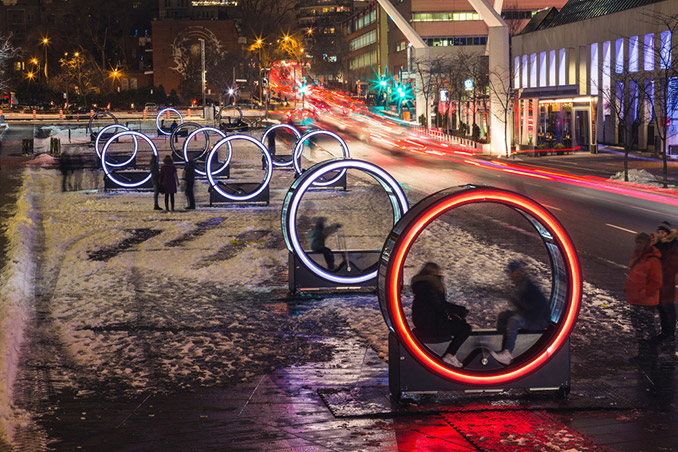
"Loop" is a public installation that consists of 13 giant zoetropes – an optical toy that was a forerunner of animated film. When a zoetrope is activate, images are shown in rapid succession, creating the illusion of motion. This illuminated musical installation, featuring a distinctive retro-futuristic look, uses cylinders two metres in diameter. Members of the public are invited to sit down inside and activate the mechanism, causing beautiful images inspired by 13 fairy tales to come to life. It’s magical! Loop is sure to spark children’s imagination and revive their parents’ childhood memories.
Loop is a cross between a music box, a zoetrope and a railway handcar – the pump-powered vehicles familiar from Bugs Bunny cartoons. The retro-futuristic machine plays animated fairy-tale loops set in motion when visitors work the lever together. When the cylinder starts spinning, it lights up, making the series of still images appear to move. A flickering strobe effect accompanies the black and white images, like in the very first movies. The animation is visible from inside or outside the cylinder and can be viewed from up close or far away. The speed at which the images move, the frequency of the flickering and the tempo of the music are determined by how fast the participants move the lever.