Scale
It is important to address scale in order to understand the size and volume of the building. In contrast to conventional displays, with dimensions commonly measured in inches, media façades and other media architectural installations do not fit into these standardizations but they are rather custom-built and designed.

Shape
Shape refers to both the outer perimeter of the media screen and the shape of the image surface. Whereas traditional displays are flat, rectangular surfaces, media façades may have any shape and even curve along the corners, bends, and curves of a building. This aspect is difficult to visualize on a two-dimensional computer screen and involves a range of examination and analysis practices.
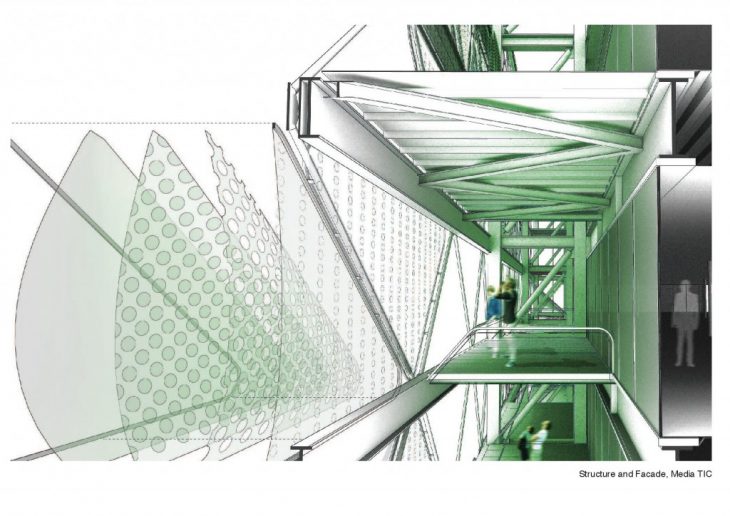
Pixel configuration Pixel configuration is the layout or pattern of pixels on the media façade, which on traditional screens is a grid system of equal and perpendicular lines. Media façades, on the other hand, may use any configuration of pixels, creating complex patterns on a building façade. Translating media content from a conventional digital medium often requires techniques like subpixel sampling in order to accommodate the non-grid configuration on some media facades.

Pixel shape
Pixel shape refers to the physical form of the pixels in the facade. Traditionally pixels are square shapes (preferably not identified as individual pixels), but on media façades, the pixels can be any shape, determined by the lighting fixture or the architectural element that structures the configurations of pixels. On some media façades, the pixel shape makes the visibility highly dependent on the viewing angle.
Light quality Light quality is crucial to how smooth colors are displayed, and how bright the media façade is. Brightness is mostly an issue of whether the media façade can be viewed in daylight or only in evening light conditions. The type of lighting fixture and the use of diffusers and reflectors may also produce visual qualities that are different forms what traditional displays may produce.

